

*Corresponding author: Shiva Borzouei, Department of Internal Medicine, School of Medicine, Hamadan University of Medical Sciences, Hamadan, Iran. Email: borzooeishiva@yahoo.com
EXTENDED ABSTRACT
Background
Type 2 diabetes mellitus is a chronic metabolic disorder characterized by persistent hyperglycemia and is responsible for substantial morbidity and mortality worldwide [1]. Sleep disturbances are reported more frequently in people with diabetes than in healthy populations [2]. Short sleep duration and poor sleep quality have also been associated with a higher risk of diabetes [3, 4], while sleep duration and sleep quality are related to glycemic control in established type 2 diabetes [5]. Obstructive sleep apnea (OSA) is a sleep-related breathing disorder characterized by partial or complete upper-airway obstruction during sleep, leading to intermittent hypoxia and sleep fragmentation [6, 7]. Its clinical consequences can include loud snoring, recurrent respiratory pauses, repeated awakening, excessive daytime sleepiness, fatigue, impaired concentration, cognitive symptoms, and mood disturbance [8-10]. Moderate-to-severe OSA is present in a meaningful proportion of the adult population [11], and evidence suggests a bidirectional relationship between OSA and metabolic dysfunction. OSA has been associated with insulin resistance and type 2 diabetes, while diabetes-related neuropathy, leptin resistance, insulin resistance, and oxidative stress may adversely affect upper-airway neuromuscular control [12-14]. Because both disorders are common and may reinforce poor metabolic and functional outcomes, practical screening for daytime sleepiness and OSA may be clinically useful in patients with type 2 diabetes. The present study therefore investigated the frequency of daytime sleepiness and the probability of OSA using the Epworth Sleepiness Scale (ESS) and STOP-BANG questionnaire and evaluated their relationships with hemoglobin A1c (HbA1c) in patients with type 2 diabetes.
Methods
This cross-sectional study was conducted in 2023 among 200 outpatients or inpatients with type 2 diabetes referred to Shahid Beheshti Educational and Treatment Center in Hamadan, Iran. Participants were 30-60 years old and had been diagnosed with type 2 diabetes for at least 2 years. Exclusion criteria were use of any sleep-inducing medication, substance addiction, a history of psychiatric or neurologic disease, and concurrent cardiac or pulmonary disease. After the study procedures had been explained, participants completed a researcher-developed demographic questionnaire covering age, sex, duration of diabetes, history of hypertension, dyslipidemia, and smoking. Height and weight were measured to calculate body mass index (BMI), and HbA1c values were obtained from patients' accompanying laboratory results and recorded. Daytime sleepiness was assessed using the eight-item ESS. Each item is scored from 0 to 3, yielding a total score of 0-24; scores above 10 were considered abnormal sleepiness. OSA probability was assessed with the eight-item STOP-BANG questionnaire, which addresses loud snoring, daytime tiredness or sleepiness, observed apnea, hypertension, age, BMI, neck circumference, and sex. STOP-BANG scores range from 0 to 8; in the source study, scores of 1-2 were classified as low probability and scores of 3-8 as high probability for OSA [15, 16]. The reported test-retest reliability of the instruments was 90%. Statistical analysis was performed with SPSS version 26. Fisher's exact test, independent-samples t test, one-way analysis of variance, Tukey post-hoc comparisons where applicable, and Spearman correlation were used. Statistical significance was defined as P<0.05. The study received ethics approval from Hamadan University of Medical Sciences (IR.UMSHA.REC.1400.974), and written informed consent was obtained from participants.
Results
The mean age of the 200 participants was 56.16 ± 9.77 years, and 53.5% were men. Mean duration of diabetes was 6.91 ± 4.51 years, mean BMI was 25.01 ± 5.14 kg/m², and mean HbA1c was 7.69 ± 2.23%. Smoking, hypertension, and dyslipidemia were reported in 26%, 64%, and 33% of participants, respectively. According to BMI categories, 4% were underweight, 61% had normal weight, 28% were overweight, and 7% were obese. The mean daytime sleepiness score was 6.83 ± 5.10 of 24, and the mean STOP-BANG score was 3.83 ± 1.34 of 8. Based on the study's sleepiness categories, 76% of participants were classified as normal, 12% as mild, 2% as moderate, and 10% as severe. STOP-BANG screening classified 21% as having a low probability and 79% as having a high probability of OSA. Glycemic control was categorized as good in 56%, moderate in 21%, and poor in 23% of patients.
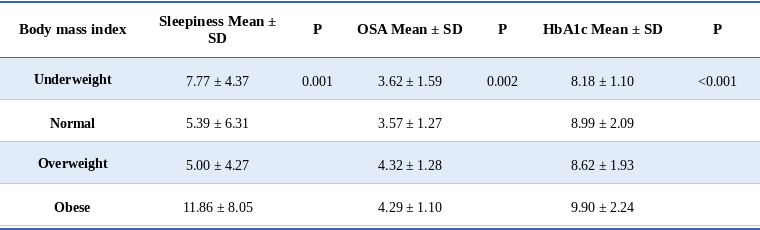
BMI was significantly associated with the mean daytime sleepiness score, STOP-BANG score, and HbA1c. Tukey comparisons showed that daytime sleepiness was significantly higher in obese patients than in those of normal weight (P=0.001), the mean STOP-BANG score was higher in overweight patients than in normal-weight patients (P=0.002), and HbA1c was higher in overweight and obese patients than in normal-weight patients (P<0.001). The numerical findings by BMI are summarized in Table 1.
Table 1. Mean daytime sleepiness, obstructive sleep apnea, and HbA1c scores according to body mass index in patients with type 2 diabetes.
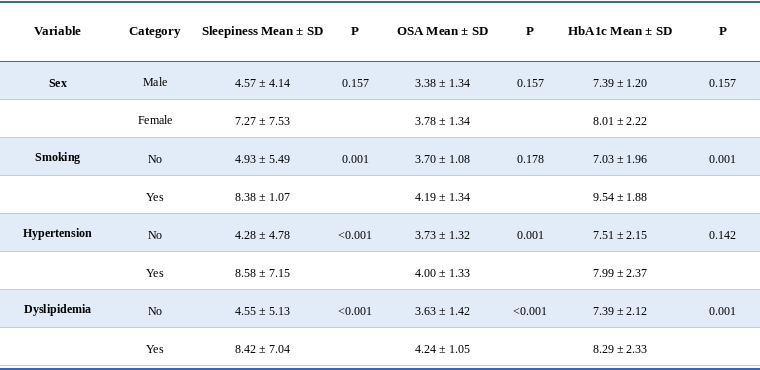
For continuous scores, mean daytime sleepiness did not differ significantly by sex, but it differed significantly according to smoking (P=0.001), hypertension (P<0.001), and dyslipidemia (P<0.001). Mean STOP-BANG scores did not differ significantly by sex or smoking status, but were significantly different according to hypertension (P=0.001) and dyslipidemia (P<0.001). Mean HbA1c did not differ significantly by sex or hypertension, whereas significant differences were observed by smoking and dyslipidemia (both P=0.001). These comparisons are presented in Table 2. When categorical distributions were examined, the frequency distribution of daytime sleepiness differed significantly by sex (P<0.001), smoking (P=0.003), hypertension (P<0.001), and dyslipidemia (P<0.001). OSA probability differed significantly by smoking (P=0.002) and dyslipidemia (P=0.001), but not by sex or hypertension. HbA1c control categories differed significantly by smoking (P<0.001) and dyslipidemia (P=0.007), but not by sex or hypertension.
Table 2. Mean daytime sleepiness, obstructive sleep apnea, and HbA1c according to sex, smoking, hypertension, and dyslipidemia.
Correlation analyses further showed that higher daytime sleepiness scores were positively associated with older age (P=0.002) and longer duration of diabetes (P=0.007). STOP-BANG score was positively associated with age (P=0.015), but not significantly with diabetes duration. HbA1c showed positive and statistically significant relationships with age (P=0.016), daytime sleepiness score (P=0.036), STOP-BANG score (P=0.034), and duration of diabetes (P=0.005). Thus, poorer long-term glycemic control was observed alongside greater daytime sleepiness and a higher probability of OSA in this sample.
Conclusion
Among patients with type 2 diabetes, excessive daytime sleepiness and a high probability of obstructive sleep apnea were relatively common. Both sleepiness and OSA screening scores were associated with poorer glycemic control, and several demographic and cardiometabolic characteristics, particularly BMI, age, smoking, hypertension, and dyslipidemia, were also related to sleep outcomes or HbA1c. These findings support attention to sleep-related symptoms as part of clinical assessment in type 2 diabetes and indicate that patients with poor glycemic control may warrant targeted evaluation for daytime sleepiness and obstructive sleep apnea.
Keywords: Diabetes Mellitus Type 2, Hemoglobin A1c, Obstructive Sleep Apnea, Sleepiness
REFERENCES
- Punjabi NM, Sorkin JD, Katzel LI, Goldberg AP, Schwartz AR, Smith PL. Sleep-disordered breathing and insulin resistance in middle-aged and overweight men. Am J Respir Crit Care Med. 2002;165(5):677-82. PMID: 11874813 DOI: 10.1164/ajrccm.165.5.2104087
- Khandelwal D, Dutta D, Chittawar S, Kalra S. Sleep disorders in type 2 diabetes. Indian J Endocrinol Metab. 2017;21(5):758-61. PMID: 28989888 DOI: 10.4103/ijem.IJEM_156_17
- Kita T, Yoshioka E, Satoh H, Saijo Y, Kawaharada M, Okada E, et al. Short sleep duration and poor sleep quality increase the risk of diabetes in Japanese workers with no family history of diabetes. Diabetes Care. 2012;35(2):313-8. PMID: 22210572 DOI: 10.2337/dc11-1455
- Sakamoto R, Yamakawa T, Takahashi K, Suzuki J, Shinoda MM, Sakamaki K, et al. Association of usual sleep quality and glycemic control in type 2 diabetes in Japanese: A cross sectional study. Sleep and Food Registry in Kanagawa (SOREKA). PLoS One. 2018;13(1):e0191771. PMID: 29364963 DOI: 10.1371/journal.pone.0191771
- Full KM, Schmied EA, Parada H, Cherrington A, Horton LA, Ayala GX. The relationship between sleep duration and glycemic control among Hispanic adults with uncontrolled type 2 diabetes. Diabetes Educ. 2017;43(5):519-29. DOI: 10.1177/0145721717724564
- Andrade AG, Bubu OM, Varga AW, Osorio RS. The relationship between obstructive sleep apnea and Alzheimer's disease. J Alzheimers Dis. 2018;64(Suppl 1):S255-70. PMID: 29782319 DOI: 10.3233/JAD-179936
- Sateia MJ. International classification of sleep disorders. Chest. 2014;146(5):1387-94. PMID: 25367475 DOI: 10.1378/chest.14-0970
- Saddki N, Mohamad H, Mohd Yusof NI, Mohamad D, Mokhtar N, Wan Bakar WZ. Validity and reliability of the Malay version of sleep apnea quality of life index-Preliminary results. Health Qual Life Outcomes. 2013;11(1):1-10. PMID: 23786866 DOI: 10.1186/1477-7525-11-100
- Sin DD, Fitzgerald F, Parker JD, Newton G, Floras JS, Bradley TD. Risk factors for central and obstructive sleep apnea in 450 men and women with congestive heart failure. Am J Respir Crit Care Med. 1999;160(4):1101-6. PMID: 10508793 DOI: 10.1164/ajrccm.160.4.9903020
- Schröder CM, O'Hara R. Depression and obstructive sleep apnea (OSA). Ann Gen Psychiatry. 2005;4:13. PMID: 15982424 DOI: 10.1186/1744-859X-4-13
- Heinzer R, Vat S, Marques-Vidal P, Marti-Soler H, Andries D, Tobback N, et al. Prevalence of sleep-disordered breathing in the general population: the HypnoLaus study. Lancet Respir Med. 2015;3(4):310-8. PMID: 25682233 DOI: 10.1016/S2213-2600(15)00043-0
- Borel A-L, Tamisier R, Böhme P, Priou P, Avignon A, Benhamou P-Y, et al. Obstructive sleep apnoea syndrome in patients living with diabetes: Which patients should be screened? Diabetes Metab. 2019;45(2):91-101. PMID: 30189344 DOI: 10.1016/j.diabet.2018.08.006
- Huang T, Lin BM, Stampfer MJ, Tworoger SS, Hu FB, Redline S. A population-based study of the bidirectional association between obstructive sleep apnea and type 2 diabetes in three prospective US cohorts. Diabetes Care. 2018;41(10):2111-9. PMID: 30072403 DOI: 10.2337/dc18-0675
- Malik JA, Masoodi SR, Shoib S. Obstructive sleep apnea in Type 2 diabetes and impact of continuous positive airway pressure therapy on glycemic control. J Endocrinol Metab. 2017;21(1):106. PMID: 28217508 DOI: 10.4103/2230-8210.196005
- Hadavandsiri F, Shafaati M, Mohammad Nejad S, Ebrahimzadeh Mousavi M, Najafi A, Mirzaei M, et al. Non-communicable disease comorbidities in HIV patients: Diabetes, hypertension, heart disease, and obstructive sleep apnea as a neglected issue. Sci Rep. 2023;13(1):12730. PMID: 37543699 DOI: 10.1038/s41598-023-39828-6
- Ahmadian M, Ziaeirad M. The relationship between sleep quality and metabolic control indicators in patients with diabetes. Nursing and Midwifery Journal. 2023;20(12):1024-34. DOI: 10.52547/unmf.20.12.1024
- Xue P, Tan X, Benedict C. Association of poor sleep and HbA1c in metformin-treated patients with type 2 diabetes: Findings from the UK Biobank cohort study. J Sleep Res. 2023;32(5):e13917. PMID: 37106473 DOI: 10.1111/jsr.13917
- Sweed RA, Wahab NHAE, El Hooshy MS, Morsy EY, Shetta DM. Obstructive sleep apnea in patients with type 2 diabetes mellitus in Egyptian population. Egypt J Bronchol. 2023;17(1):55. DOI: 10.1186/s43168-023-00224-3
- Ghanei GR, Hemmati M, Baghi V. A study on the relation between body mass index and sleep apnea in patients suffering diabetes type 2. Journal of Diabetes Nursing. 2014;2(1).
- Foster GD, Sanders MH, Millman R, Zammit G, Borradaile KE, Newman AB, et al. Obstructive sleep apnea among obese patients with type 2 diabetes. Diabetes Care. 2009;32(6):1017-9. PMID: 19279303 DOI: 10.2337/dc08-1776
- Nagayoshi M, Punjabi NM, Selvin E, Pankow JS, Shahar E, Iso H, et al. Obstructive sleep apnea and incident type 2 diabetes. Sleep Med. 2016;25:156-61. PMID: 27810258 DOI: 10.1016/j.sleep.2016.05.009
- Barakat S, Abujbara M, Banimustafa R, Batieha A, Ajlouni K. Sleep quality in patients with type 2 diabetes mellitus. J Clin Med Res. 2019;11(4):261. PMID: 30937116 DOI: 10.14740/jocmr2947w
- Purani H, Friedrichsen S, Allen AM. Sleep quality in cigarette smokers: Associations with smoking-related outcomes and exercise. Addict Behav. 2019;90:71-6. PMID: 30368021 DOI: 10.1016/j.addbeh.2018.10.023
- Hamidovic A, de Wit H. Sleep deprivation increases cigarette smoking. Pharmacol Biochem Behav. 2009;93(3):263-9. PMID: 19133287 DOI: 10.1016/j.pbb.2008.12.005
- Choi D-W, Jeon J, Lee SA, Han K-T, Park E-C, Jang S-I. Association between smoking behavior patterns and glycated hemoglobin levels in a general population. Int J Environ Res Public Health. 2018;15(10):2260. PMID: 30332732 DOI: 10.3390/ijerph15102260
- Artese A, Stamford BA, Moffatt RJ. Cigarette smoking: an accessory to the development of insulin resistance. Am J Lifestyle Med. 2019;13(6):602-5. PMID: 31662726 DOI: 10.1177/1559827617726516