

*Corresponding author: Fatemeh Pakrad, Department of Community Health Nursing, School of Nursing and Midwifery, Chronic Diseases (Home Care) Research Center, Hamadan University of Medical Sciences, Hamadan, Iran. Email: f_pakrad@yahoo.com
EXTENDED ABSTRACT
Background
Cardiovascular diseases remain a leading cause of mortality worldwide [1] and are also a major cause of death and disability in Iran [2]. Cardiac dysrhythmias contribute substantially to cardiovascular mortality because malignant ventricular arrhythmias may cause sudden cardiac death, sometimes in patients without preceding symptoms [3–5]. Implantable cardioverter-defibrillators (ICDs) continuously monitor cardiac rhythm and can deliver life-saving therapy when life-threatening ventricular tachyarrhythmias occur. They are widely used in patients with heart failure or other conditions associated with ventricular fibrillation, symptomatic ventricular tachycardia, or high risk of sudden cardiac death [8–12]. However, ICD implantation does not eliminate mortality risk. Device-related complications, underlying cardiac dysfunction, comorbid disease, and patient characteristics may influence long-term outcomes [13]. Previous studies have reported associations between mortality after ICD implantation and older age, low ejection fraction, renal dysfunction, atrial fibrillation, and other clinical factors [14–16]. Because survival data and mortality predictors among Iranian ICD recipients have been limited, the present study was conducted to estimate survival and identify factors associated with mortality after ICD implantation at Farshchian Heart Center in Hamadan, Iran.
Methods
This mixed cohort study included patients who underwent ICD implantation at Farshchian Heart Center, Hamadan. The prospective component comprised 180 patients treated during 2019–2020, while the retrospective component included 45 patients who had undergone ICD implantation from the beginning of 2017 through the end of 2018 and whose survival status was assessed in 2020. Census sampling was used and 225 eligible patients were included. Eligibility required ICD implantation during 2017–2020 and sufficient cooperation and information for completion of the study checklist; patients with incomplete information required for the checklist were excluded. Data collection used a two-part checklist. The first part captured diagnosis, previous diseases, diagnostic tests, demographic variables, clinical characteristics, and laboratory findings from the hospital information system and electronic medical records. The second part recorded short- and long-term complications after ICD implantation, including infection, hemothorax, bleeding, and lead displacement, together with mortality status. Follow-up information was obtained by telephone interview with patients or relatives using contact information recorded in the medical file. Permission for access to discharged patients’ records was obtained from the university ethics committee, and verbal consent was obtained from patients or relatives, including relatives of deceased patients, before telephone data collection. Quantitative variables were compared using the independent-samples t test and qualitative variables using the chi-square test. Survival time was estimated with the Kaplan–Meier method. Factors associated with survival were examined with univariable and multivariable Cox proportional hazards regression. Analyses were performed using Stata version 14. The research was approved by the Ethics Committee of Hamadan University of Medical Sciences (IR.UMSHA.REC.1398.042).
Results
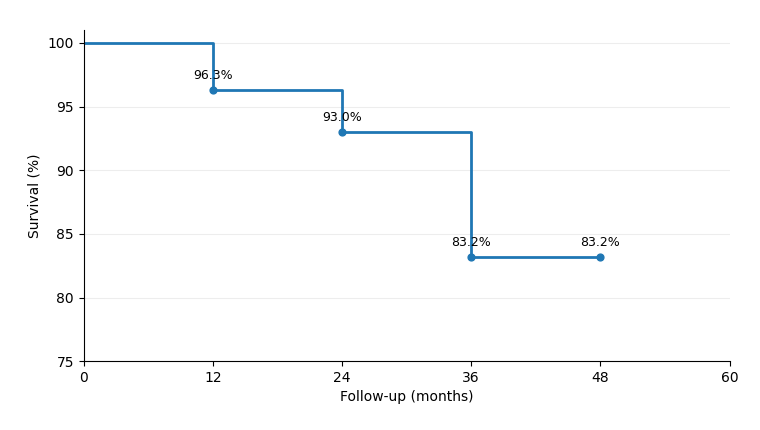
Among the 225 patients, 183 (80.88%) were male. Ninety-one patients (40.44%) were 55–65 years old and 87 (34.66%) were older than 65 years; 159 (71.30%) lived in urban areas. Fifty-one patients (22.77%) had a history of smoking, 54 (24.00%) had a history of substance use, 84 (37.33%) had hypertension, and 48 (21.33%) had valvular heart disease. During follow-up, 25 deaths (11.1%) were recorded. The reported 1-, 2-, 3-, and 4-year survival rates were 96.3%, 93.0%, 83.2%, and 83.2%, respectively. Two hundred patients reached the second year of follow-up, 153 reached the third year, and 70 reached the fourth year.
Figure 1. Survival after ICD implantation across follow-up, reconstructed from the exact survival proportions reported in the source article.
In univariable Cox analysis, mortality risk was lower in men than in women (HR 0.38, 95% CI 0.17–0.87; P=0.021). Normal hemoglobin was associated with lower mortality than low hemoglobin (HR 0.13, 95% CI 0.05–0.29; P=0.001), and high hemoglobin was also associated with lower mortality (HR 0.18, 95% CI 0.04–0.85; P=0.031). Normal hematocrit was associated with lower mortality than low hematocrit (HR 0.13, 95% CI 0.05–0.35; P=0.001). Higher blood urea nitrogen was associated with increased mortality (HR 3.45, 95% CI 1.55–7.71; P=0.002), and elevated creatinine was likewise associated with increased mortality (HR 2.49, 95% CI 1.11–5.55; P=0.026). These associations did not remain statistically significant after multivariable adjustment.
Table 1. Key multivariable Cox regression findings for mortality after ICD implantation (selected rows from the original Table 1; values reproduced exactly).
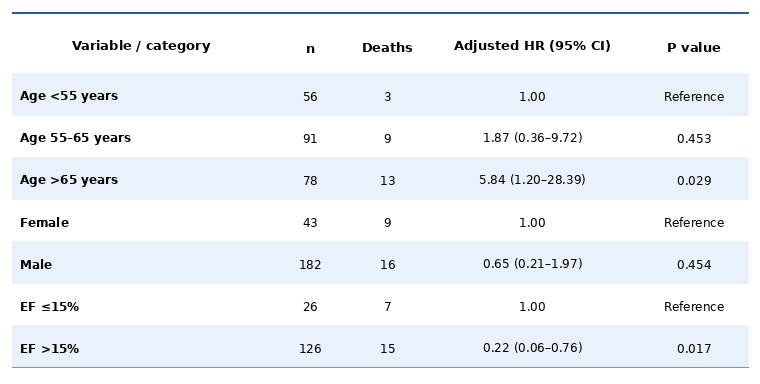
In the multivariable Cox model, age and ejection fraction were the principal independent predictors. Patients older than 65 years had a markedly higher mortality risk than patients younger than 55 years (adjusted HR 5.84, 95% CI 1.20–28.39; P=0.029). Patients aged 55–65 years did not differ significantly from the younger reference group (adjusted HR 1.87, 95% CI 0.36–9.72; P=0.453). An ejection fraction greater than 15% was associated with substantially lower mortality risk (adjusted HR 0.22, 95% CI 0.06–0.76; P=0.017), indicating higher risk among patients with an ejection fraction of 15% or less. Sex was no longer significant after adjustment (adjusted HR for men 0.65, 95% CI 0.21–1.97; P=0.454). Pacemaker type, residence, smoking, substance use, hypertension, valvular disease, ICD implantation site, previous myocardial infarction, indication for ICD implantation, history of arrhythmia, dyspnea, apnea, heart failure, pulmonary disease, fasting blood glucose, PT, PTT, cholesterol, HDL, LDL, creatinine, sodium, and potassium were not independently associated with mortality. The study was limited to a single specialized center and lacked sufficiently complete data on some socioeconomic, behavioral, and psychological factors, which restricted evaluation of their potential contribution to mortality.
Conclusion
In patients receiving an ICD, age older than 65 years and severe reduction in ejection fraction were associated with increased mortality. The survival estimates declined mainly during the later follow-up period, while the adjusted analysis identified advanced age and cardiac functional impairment as the most important prognostic factors. Patients with these characteristics should therefore receive particularly careful clinical follow-up after ICD implantation. Larger multicenter studies with more complete assessment of comorbid, behavioral, and psychosocial factors are needed to provide more precise estimates.
Keywords: Implantable Defibrillator, Mortality, Risk Factors, Survival
REFERENCES
- Roth GA, Johnson C, Abajobir A, Abd-Allah F, Abera SF, Abyu G, et al. Global, Regional, and National Burden of Cardiovascular Diseases for 10 Causes, 1990 to 2015. J Am Coll Cardiol. 2017;70(1):1-25. PMID: 28527533 DOI: 10.1016/j.jacc.2017.04.052
- Krzemień-Wolska K, Tomasik A, Wojciechowska C, Barańska-Pawełczak K, Nowalany-Kozielska E, Jacheć W. Prognostic factors in patients with an implanted pacemaker after 80 years of age in a 4-year follow-up. Gerontology. 2018;64(2):107-17. DOI: 10.1159/000481504
- Pellegrini CN, Lee K, Olgin JE, Turakhia MP, Tseng ZH, Lee R, et al. Impact of advanced age on survival in patients with implantable cardioverter defibrillators. Europace. 2008;10(11):1296-301. PMID: 18818212 DOI: 10.1093/europace/eun253
- Tavan H, Norouzi S, Shohani M. Teaching cardiac arrhythmias using educational videos and simulator software in nurses: An educational interventional study. Shiraz E-Med J. 2020;21(9):e97984. DOI: 10.5812/semj.97984
- Yue T, Chen BH, Wu LM, Xu JR, Pu J. Prognostic Value of Late Gadolinium Enhancement in Predicting Life-Threatening Arrhythmias in Heart Failure Patients With Implantable Cardioverter-Defibrillators: A Systematic Review and Meta-Analysis. J Magn Reson Imaging. 2020;51(5):1422-39. DOI: 10.1002/jmri.26982
- Perez Diaz P, Jimenez Diaz J, Higuera Sobrino F, Piqueras Flores J, Maseda Uriza R, Mazoteras Munoz V, et al. P1792 Medium-long term mortality in elderly patients with pacemaker: Retrospective observational study. EP Europace. 2017;19(3):iii396-iii. DOI: 10.1093/ehjci/eux161.102
- Kutyifa V, Naqvi SY, Brown M, McNitt S, Goldenberg I, Klein H, et al. Comparison of long-term survival benefits with cardiac resynchronization therapy in patients with mild heart failure with versus without diabetes mellitus (from the Multicenter Automatic Defibrillator Implantation Trial with Cardiac Resynchronization Therapy [MADIT-CRT]). Am J Cardiol. 2018;121(12):1567-74. PMID: 29625702 DOI: 10.1016/j.amjcard.2018.02.040
- van Rees JB, de Bie MK, Thijssen J, Borleffs CJW, Schalij MJ, van Erven L. Implantation-related complications of implantable cardioverter-defibrillators and cardiac resynchronization therapy devices: a systematic review of randomized clinical trials. J Am Coll Cardiol. 2011;58(10):995-1000. PMID: 21867832 DOI: 10.1016/j.jacc.2011.06.007
- Khadir Sharabiany V, Oraii S. Pacemaker implantation by surgeons and cardiologists: Comparing two different eras. J Arak Uni Med Sci. 2010;12(4):19-24.
- Ali-Akbari F, Khalifehzadeh A, Parvin N. The effect of short time telephone follow-up on physical conditions and quality of life in patients after pacemaker implantation. Journal of Shahrekord University of Medical Sciences. 2009;11(3):23-8.
- Raatikainen MP, Arnar DO, Zeppenfeld K, Merino JL, Levya F, Hindriks G, et al. Statistics on the use of cardiac electronic devices and electrophysiological procedures in the European Society of Cardiology countries: 2014 report from the European Heart Rhythm Association. Europace. 2015;17(suppl_1):i1-75. PMID: 25616426 DOI: 10.1093/europace/euu300
- Buckley U, Shivkumar K. Implantable cardioverter defibrillators: even better than we thought? Eur Heart J. 2015;36(26):1646-8. DOI: 10.1093/eurheartj/ehv158
- Goldstein RE, McCarthy ML, Krone RJ, Haigney MC, Zareba W, Moss AJ. Fatal arrhythmia and sudden unexpected death in patients with an implanted cardiac defibrillator and post-mortem interrogation in MADIT-CRT. J Am Coll Cardiol. 2018;71(11):A484.
- Nägele H, Gröene E, Stierle D, Nägele MP. Analysis of causes of death in patients with implanted defibrillators. Clin Res Cardiol. 2021;110:895-904. DOI: 10.1007/s00392-021-01825-y
- Hawkins NM, Grubisic M, Andrade JG, Huang F, Ding L, Gao M, et al. Long-term complications, reoperations and survival following cardioverter-defibrillator implant. Heart. 2018;104(3):237-43. DOI: 10.1136/heartjnl-2017-311638
- Demarchi A, Cornara S, Sanzo A, Savastano S, Petracci B, Vicentini A, et al. Incidence of Ventricular Arrhythmias and 1-Year Predictors of Mortality in Patients Treated With Implantable Cardioverter-Defibrillator Undergoing Generator Replacement. J Am Heart Assoc. 2021;10(4):e018090. PMID: 33522246 DOI: 10.1161/JAHA.120.018090
- Ataei E, Dalvandi A, Nikpajouh A. The effect of patient education about self-care behaviors with media clips on self-care among patients with permanent pacemaker. Cardiovascular Nursing Journal. 2013;2(3):6-15.
- Kao C-W, Friedmann E, Thomas SA. Quality of life predicts one-year survival in patients with implantable cardioverter defibrillators. Qual Life Res. 2010;19:307-15. DOI: 10.1007/s11136-010-9596-6
- Zoni-Berisso M, Martignani C, Ammendola E, Narducci ML, Caruso D, Miracapillo G, et al. Mortality after cardioverter-defibrillator replacement: results of the DECODE survival score index. Eur Heart J. 2021;18(3):411-8. PMID: 36263789 DOI: 10.1093/eurheartj/ehac576
- Tandri H, Griffith LS, Tang T, Nasir K, Zardkoohi O, Reddy CV, et al. Clinical course and long-term follow-up of patients receiving implantable cardioverter-defibrillators. Heart Rhythm. 2006;3(7):762-8. PMID: 16818202 DOI: 10.1016/j.hrthm.2006.03.027
- Levine JH, Mellits ED, Baumgardner RA, Veltri EP, Mower M, Grunwald L, et al. Predictors of first discharge and subsequent survival in patients with automatic implantable cardioverter-defibrillators. Circulation. 1991;84(2):558-66. PMID: 1860200 DOI: 10.1161/01.cir.84.2.558
- Akoudad S, Abkenari LD, Schaer BA, Sticherling C, Levy WC, Jordaens L, et al. Comparison of multivariate risk estimation models to predict prognosis in patients with implantable cardioverter defibrillators with or without cardiac resynchronization therapy. Am J Cardiol. 2017;119(9):1414-20. DOI: 10.1016/j.amjcard.2017.01.035
- Winkler A, Jaguś-Jamioła A, Uziębło-Życzkowska B, Orski Z, Krzyżanowski K, Smalc-Stasiak M, et al. Predictors of appropriate interventions and mortality in patients with implantable cardioverter-defibrillators. Pol Arch Intern Med. 2019;129(10):667-72.
- Goldenberg I, Barsheshet A, Laish-Farkash A, Swissa M, Schliamser JE, Michowitz Y, et al. Anemia and the risk of life-threatening ventricular tachyarrhythmias from the Israeli implantable cardioverter defibrillator registry. Am J Cardiol. 2017;120(12):2187-92. DOI: 10.1016/j.amjcard.2017.08.041
- Bruch C, Bruch C, Sindermann J, Breithardt G, Gradaus R. Prevalence and prognostic impact of comorbidities in heart failure patients with implantable cardioverter-defibrillator. Europace. 2007;9(8):681-6. DOI: 10.1093/europace/eum097
- Cygankiewicz I, Gillespie J, Zareba W, Brown MW, Goldenberg I, Klein H, et al. Predictors of long-term mortality in Multicenter Automatic Defibrillator Implantation Trial II (MADIT II) patients with implantable cardioverter-defibrillators. Heart Rhythm. 2009;6(4):468-73. PMID: 19324304 DOI: 10.1016/j.hrthm.2008.12.023
- Alhakak A, Østergaard L, Butt JH, Vinther M, Philbert BT, Jacobsen PK, et al. Cause-specific death and risk factors of 1-year mortality after implantable cardioverter-defibrillator implantation: a nationwide study. Eur Heart J Qual Care Clin Outcomes. 2022;8(1):39-49. DOI: 10.1093/ehjqcco/qcaa074