

*Corresponding author: Behzad Imani, Department of Operating Room, School of Paramedicine, Hamadan University of Medical Sciences, Hamadan, Iran. Email: behzadiman@yahoo.com
EXTENDED ABSTRACT
Background
Benign prostatic hyperplasia (BPH) is a chronic progressive disorder and the most common benign tumor in men [1, 2]. Its prevalence rises substantially with age, from approximately 8% in men aged 31-40 years to 40-50% in men aged 51-60 years and as high as 80% in men older than 80 years [3]. Medical therapy is generally the first treatment option, but adverse effects and inadequate control of complications such as hematuria, recurrent infection, bladder stones, and lower urinary tract symptoms may lead to surgical management [4]. Transurethral resection of the prostate is widely considered the standard surgical treatment, although prostate size, resection time, access to equipment, and operator training can limit its use [5, 6]. For large prostates, particularly when bladder stones or diverticula coexist, open or endoscopic enucleation remains an important management option [7].
Open simple prostatectomy continues to be used in many developing settings [8] and can be performed through suprapubic or retropubic approaches. The suprapubic operation provides direct access to the bladder and bladder neck [9], whereas the retropubic Millin technique avoids entry into the bladder and can facilitate hemostasis and exposure [10]. Suprapubic prostatectomy is commonly performed through a central lower abdominal incision [11], which may be fashioned as either a lower midline incision or a transverse Pfannenstiel incision [12]. Because incision orientation may influence exposure, operative efficiency, postoperative pain, blood loss, and scar appearance, this randomized clinical trial compared the Pfannenstiel and lower midline incisions during simple open prostatectomy, with operative time, postoperative pain, intraoperative bleeding, and postoperative scar quality as the principal outcomes.
Methods
This randomized clinical trial was conducted at Shahid Beheshti Hospital in Hamadan during 2022. Eligible patients were conscious, able to communicate effectively, willing to participate, and free of conditions or medications expected to impair wound healing or increase bleeding, including immunosuppressive or anticoagulant use, tobacco use, diabetes, chronic anemia, chronic skin disease, allergy history, infected surgical wounds, pacemakers, or prosthetic heart valves. Exclusion criteria included withdrawal of consent and inability to complete follow-up. Sample-size calculations, based on a previous comparison of Pfannenstiel and midline incisions [16], allowed for 30% attrition and yielded approximately 31 patients per group. Eighty-one patients were assessed, 19 were excluded, and 62 were randomized equally to a Pfannenstiel group (P) or a lower midline group (L) using block randomization in blocks of four. The same surgeon and operating-room nurse, both experienced with the two incision types, participated in all procedures, and all patients received spinal anesthesia.
Skin incision was made with a scalpel, and bleeding during accessible phases was controlled with pressure and electrocautery. Incision time, time from skin incision to bladder exposure, enucleation time, total operation time to the last suture, and total operation time to final dressing application were recorded with a digital timer. Blood loss was calculated by weighing gauze before and after use, using the equivalence of 1 g to 1 mL, and by subtracting irrigation fluid from the total suctioned volume [13]. Surgical wounds were closed subcuticularly with 3-0 nylon and inspected during postoperative dressing changes. Pain was evaluated with a 0-10 visual analogue scale (VAS) [14] at the first postoperative assessment after resolution of spinal anesthesia and again 12 and 24 hours later. Scar quality was assessed one month after surgery by the Manchester Scar Scale, in which higher scores indicate poorer scar appearance [15]. Age and body mass index were compared to assess baseline similarity. Continuous outcomes were analyzed with independent-samples t tests using SPSS version 23. The study was approved by the Ethics Committee of Hamadan University of Medical Sciences (IR.UMSHA.REC.1401.463) and registered as IRCT20220822055769N1; written informed consent was obtained from all participants.
Results
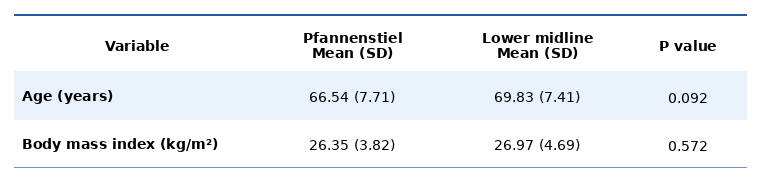
All 62 randomized patients completed the study and one-month scar follow-up, with 31 patients analyzed in each group. The groups were comparable at baseline: mean age was 66.54±7.71 years in the Pfannenstiel group and 69.83±7.41 years in the lower midline group (P=0.092), while mean body mass index was 26.35±3.82 and 26.97±4.69 kg/m², respectively (P=0.572). Hemoglobin, prothrombin time, and partial thromboplastin time were also similar. Although the INR differed statistically between groups, the authors considered this difference clinically insignificant.
Figure 1. Participant flow through the randomized clinical trial.
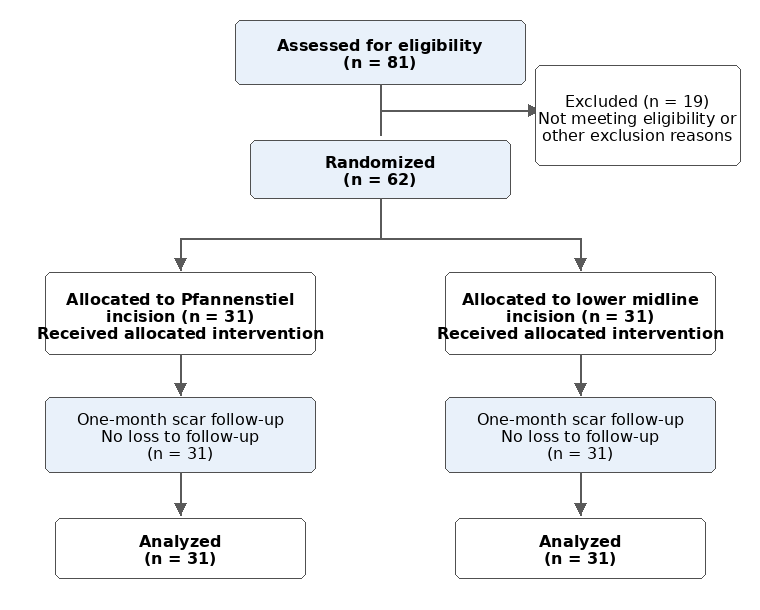
Table 1. Comparison of age and body mass index between the study groups.
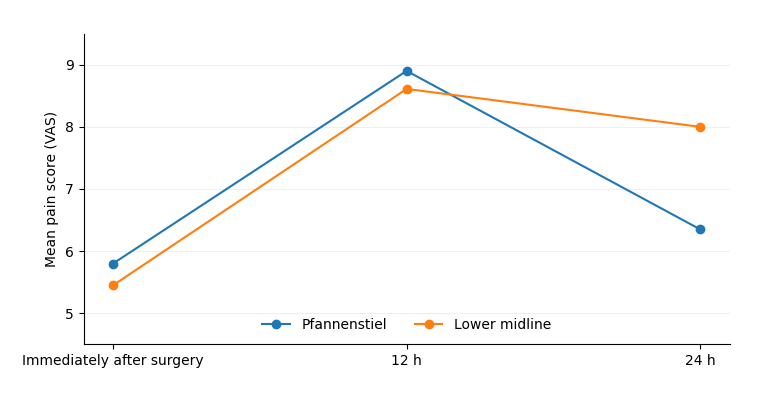
Postoperative pain immediately after surgery and at 12 hours did not differ significantly between the two incision groups. At 24 hours, however, the mean VAS pain score was significantly lower with the Pfannenstiel incision (6.35±1.20) than with the lower midline incision (8.00±1.23; P<0.001). The pattern of change over time showed similar early pain levels, a rise at 12 hours in both groups, and a substantially greater decline by 24 hours in the Pfannenstiel group.
Figure 2. Changes in mean postoperative pain score in the two study groups.
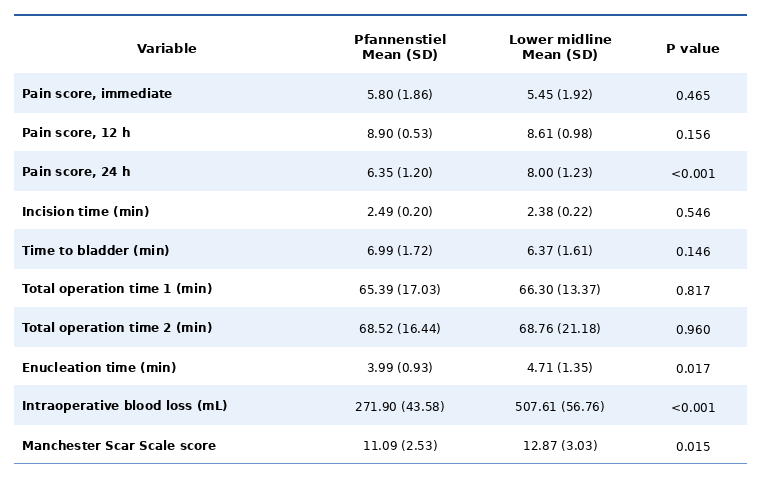
Operative access times were broadly similar. Mean incision time was 2.49±0.20 minutes with Pfannenstiel versus 2.38±0.22 minutes with lower midline incision (P=0.546), and time to bladder exposure was 6.99±1.72 versus 6.37±1.61 minutes (P=0.146). Total operation time to the last suture was 65.39±17.03 versus 66.30±13.37 minutes (P=0.817), and total time to final dressing was 68.52±16.44 versus 68.76±21.18 minutes (P=0.960). In contrast, enucleation time was significantly shorter in the Pfannenstiel group (3.99±0.93 minutes) than in the lower midline group (4.71±1.35 minutes; P=0.017). Intraoperative blood loss showed the largest between-group difference: 271.90±43.58 mL with Pfannenstiel compared with 507.61±56.76 mL with lower midline incision (P<0.001). At one month, the Manchester Scar Scale score was also lower in the Pfannenstiel group (11.09±2.53) than in the lower midline group (12.87±3.03; P=0.015), indicating a more favorable cosmetic scar. No postoperative wound complications were reported in either group during follow-up.
Table 3. Comparison of postoperative pain, operative times, blood loss, and scar score between the two incision groups.
Conclusion
In patients undergoing simple open prostatectomy, the Pfannenstiel incision provided clinically favorable outcomes compared with the lower midline incision. It was associated with markedly less intraoperative blood loss, shorter enucleation time, lower pain at 24 hours, and a better one-month scar score, while incision time, time to bladder exposure, and overall operation duration were similar. No wound complications occurred in either group. Within the conditions of this randomized trial, the Pfannenstiel incision was therefore considered preferable to the lower midline incision for simple open prostatectomy because it combined reduced bleeding and postoperative pain with improved cosmetic outcome.
Keywords: Prostatectomy, Prostatic Hyperplasia, Surgical Incision
REFERENCES
- Wei S, Cheng F, Yu WJUJ. The clinical application of combination suprapubic prostatectomy with transurethral resection of the prostate (TURP) in patients with large volume benign prostatic hyperplasia (BPH). Urologia. 2020;87(2):65-9. PMID: 30868937 DOI: 10.1177/0391560319834492
- Obi A, Okeke C, Ulebe A, Ogbobe U. The modified suprapubic prostatectomy technique is associated with improved hemostasis and decline in blood transfusion rate after open suprapubic prostatectomy compared to the Freyers technique. Niger J Clin Pract. 2022;25(4):432. PMID: 35439901 DOI: 10.4103/njcp.njcp_1391_21
- Barbosa ARG, Takemura LS, Amaral BS, Wroclawski ML, Alfer Jr W, Gil AO, et al. Benign prostatic hyperplasia surgical treatment trends in the Public Health System in Sao Paulo, Brazil. Einstein. 2022;20:eAO6880. PMID: 35730806 DOI: 10.31744/einstein_journal/2022AO6880
- Checcucci E, Veccia A, De Cillis S, Piramide F, Volpi G, Amparore D, et al. New ultra-minimally invasive surgical treatment for benign prostatic hyperplasia: a systematic review and analysis of comparative outcomes. Eur Urol Open Sci. 2021;33:28-41. PMID: 34604814 DOI: 10.1016/j.euros.2021.08.009
- Shah AA, Gahan JC, Sorokin I. Comparison of robot-assisted versus open simple prostatectomy for benign prostatic hyperplasia. Curr Urol Rep. 2018;19(9):1-8. PMID: 29998354 DOI: 10.1007/s11934-018-0820-1
- Norouzi N, Imani B. Clinical education stressors in operating room students: a qualitative study. Invest Educ Enferm. 2021;39(1). PMID: 33687812 DOI: 10.17533/udea.iee.v39n1e08
- Amu OC, Affusim EA, Nnadozie UU, Mbadiwe O. Malament stitch and increased risk of bladder neck stenosis: any association following open prostatectomy in Enugu Southeast Nigeria. BMC Urol. 2022;22(1):1-7. PMID: 35027026 DOI: 10.1186/s12894-021-00944-y
- Abedi AR, Allameh F, Hojjati SA, Ghiasy S, Pouri M, Montazeri S. The Feasibility of Open Prostatectomy in Patients with History of Previous Prostate Surgery. Urol J. 2022;19(2):148-151. PMID: 35066864 DOI: 10.22037/uj.v18i.6468
- Freyer P. A new method of performing perineal prostatectomy. Br Med J. 1900;1(2047):698. PMID: 20758920 DOI: 10.1136/bmj.1.2047.698-a
- Millin T. Retropubic prostatectomy a new extravesical technique: report on 20 cases. Lancet. 1945;246(6379):693-6. PMID: 21007347 DOI: 10.1016/s0140-6736(45)91030-0
- McDougal WS, Wein AJ, Kavoussi LR, Partin AW, Peters CA. Campbell-Walsh Urology 11th Edition Review E-Book. Elsevier Health Sciences. 2015.
- Cho JM, Moon KT, Lee JH, Choi JD, Kang JY, Yoo TK. Open simple prostatectomy and robotic simple prostatectomy for large benign prostatic hyperplasia: comparison of safety and efficacy. Prostate Int. 2021;9(2):101-6. DOI: 10.1016/j.prnil.2020.11.004
- Phillips N, Hornacky A. Berry & Kohn's Operating Room Technique-E-Book. Elsevier Health Sciences. 2020.
- Ho K, Spence J, Murphy MFJAoem. Review of pain-measurement tools. Ann Emerg Med. 1996;27(4):427-32. PMID: 8604852 DOI: 10.1016/s0196-0644(96)70223-8
- Vercelli S, Ferriero G, Sartorio F, Stissi V, Franchignoni F. How to assess postsurgical scars: a review of outcome measures. Disabil Rehabil. 2009;31(25):2055-63. PMID: 19888834 DOI: 10.3109/09638280902874196
- Tak GR, Ganpule AP, Singh AG, Sengar APS, Vijayakumar M, Balaji SS, et al. Pfannenstiel vs. midline incision for urinary diversion, following minimally invasive radical cystectomy: single center experience. Mini Invasive Surg. 2018;2:15. DOI: 10.20517/2574-1225.2018.05
- Salonia A, Suardi N, Crescenti A, Zanni G, Fantini GV, Gallina A, et al. Pfannenstiel versus vertical laparotomy in patients undergoing radical retropubic prostatectomy with spinal anesthesia: results of a prospective, randomized trial. Eur Urol. 2005;47(2):202-8. PMID: 15661415 DOI: 10.1016/j.eururo.2004.07.025
- Brown SR, Goodfellow PB. Transverse verses midline incisions for abdominal surgery. Cochrane Database Syst Rev. 2005;2005(4):CD005199. PMID: 16235395 DOI: 10.1002/14651858.CD005199.pub2
- Lunacek A, Radmayr C, Horninger W, Plas E. Pfannenstiel incision for radical retropubic prostatectomy as a surgical and cosmetic alternative to the midline or laparoscopic approach: A single center study. Cent European J Urol. 2014;67(2):149-52. PMID: 25140228 DOI: 10.5173/ceju.2014.02.art6
- Gratzke C, Schlenker B, Seitz M, Karl A, Hermanek P, Lack N, et al. Complications and early postoperative outcome after open prostatectomy in patients with benign prostatic enlargement: results of a prospective multicenter study. J Urol. 2007;177(4):1419-22. PMID: 17382744 DOI: 10.1016/j.juro.2006.11.062
- Soulie M, Vazzoler N, Seguin P, Attalah F, Pontonnier F, Plante P. Pfannenstiel short horizontal laparotomy in retropubic radical prostatectomy. Progres en Urologie: Journal de L'association Francaise D'urologie et de la Societe Francaise D'urologie. 2000;10(6):1169-72.