

1 Master of Counseling in Midwifery, Faculty of Nursing and Midwifery, Iran University of Medical Sciences, Tehran, Iran
2 Nursing and Midwifery Care Research Center, Health Management Research Institute, Iran University of Medical Sciences, Tehran, Iran
3 Department of Brain and Cognitive Sciences, Royan Institute of Stem Cell Biology and Technology, Jahad, Tehran, Iran
*Corresponding author: Leila Amini, Nursing and Midwifery Care Research Center, Health Management Research Institute, Iran University of Medical Sciences, Tehran, Iran. Email: amini.l@iums.ac.ir
EXTENDED ABSTRACT
Background
Multiple sclerosis (MS) is a chronic autoimmune neurological disorder of the central nervous system that affects approximately 2.8 million people worldwide [1]. In Iran, reported prevalence ranges from 14.7 to 101.4 per 100,000 population, and the disease disproportionately affects women, particularly during young adulthood and the reproductive years [2-4]. MS can impair reproductive and sexual health through neurological, hormonal, psychological, and functional pathways. Sexual dysfunction has been reported in more than 60% of women with MS and may include reduced sexual activity and desire, diminished genital sensation and lubrication, and orgasmic difficulties [9, 10]. These problems may occur early in the course of the disease and can adversely affect sexual satisfaction, intimacy, marital relationships, and overall quality of life [11-14]. Psychological approaches have therefore been explored alongside routine medical care. Expressive writing, which encourages individuals to translate emotionally meaningful experiences into written language, has shown beneficial effects on body image, sexual dysfunction, anxiety, stress, and broader health-related outcomes in different populations, including people with MS [8, 15-19]. Because few studies have directly examined sexual and marital satisfaction as outcomes of expressive writing in women with MS, the present randomized clinical trial evaluated whether a brief home-based expressive-writing intervention could improve sexual satisfaction and marital satisfaction in married women with MS.
Methods
This randomized clinical trial with a control group was conducted among married women with MS attending a selected specialized neurology and MS clinic in Tehran, Iran. A total of 104 women aged 18-45 years were enrolled and randomly allocated, using a random-number table, to intervention and control groups of 52 participants each. Eligibility required at least basic literacy, at least six months since MS diagnosis, at least one sexual intercourse episode during the preceding month, no pregnancy or breastfeeding, no other chronic disease apart from MS, and no use of psychotropic drugs, alcohol, narcotics, hallucinogens, or medications affecting sexual desire or function in either partner. Women also had to report no major stressful event during the previous three months and needed access to virtual communication platforms for follow-up. Participants were free to withdraw at any stage.
Data were collected using a demographic questionnaire, the Larson Sexual Satisfaction Questionnaire, and the ENRICH Marital Satisfaction Questionnaire. The Larson instrument contains 25 items covering desire for sexual relations, sexual attitude, sexual quality of life, and sexual compatibility; total scores range from 25 to 125, with higher scores indicating greater sexual satisfaction. Its Persian version had previously demonstrated acceptable reliability [21]. The 35-item ENRICH instrument evaluates marital satisfaction, communication, conflict resolution, and idealistic distortion, with higher scores indicating greater marital satisfaction; the Persian version has also demonstrated acceptable reliability [22, 23].
After baseline assessment and individual explanation of the intervention, women in the intervention group performed self-directed expressive writing at home for four consecutive weeks, at least one day each week. They were instructed to use a “morning pages” approach, writing freely for at least 30 minutes about feelings, thoughts, and emotions without concern for spelling or composition, preferably in a quiet setting soon after awakening. The researcher used scheduled telephone contacts to remind participants about the writing process. At the end of the four-week period, both groups completed the sexual and marital satisfaction questionnaires again. Data were analyzed using SPSS version 20 with independent and paired t tests, chi-square tests, and nonparametric equivalents as appropriate. Statistical significance was defined as P<0.05. The study was approved by the Iran University of Medical Sciences ethics committee (IR.IUMS.REC.1399.716), registered in the Iranian Registry of Clinical Trials (IRCT20110629006917N5), and conducted after written informed consent was obtained.
Results
The intervention and control groups were homogeneous for all assessed baseline characteristics, including participant age, spouse age, age at marriage, age at disease onset, number of children, educational level, spouse education, employment, spouse occupation, economic status, and previous sexual education. Mean participant age was 32.35±6.33 years in the control group and 34.00±6.30 years in the intervention group; mean spouse age was 37.75±6.84 and 38.63±7.09 years, respectively. Most participants and their spouses had university education, and most reported relatively favorable economic status.
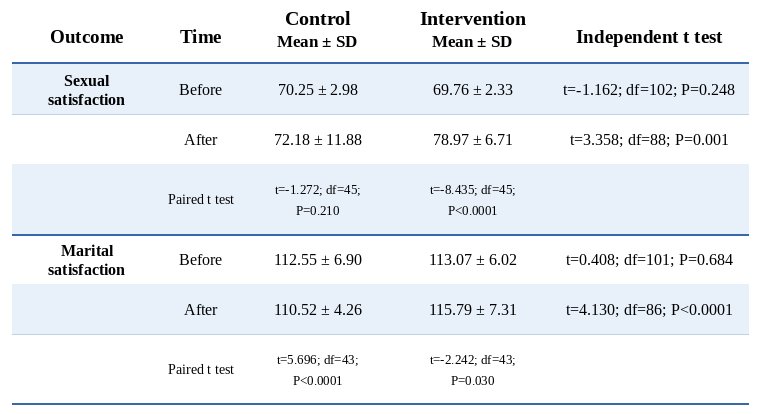
Before the intervention, sexual satisfaction did not differ significantly between the groups (control 70.25±2.98 versus intervention 69.76±2.33; t=-1.162, df=102, P=0.248). After four weeks, sexual satisfaction was significantly higher in the intervention group (78.97±6.71) than in the control group (72.18±11.88; t=3.358, df=88, P=0.001). Within-group analysis showed a significant increase in sexual satisfaction in the intervention group (t=-8.435, df=45, P<0.0001), whereas the change in the control group was not significant (t=-1.272, df=45, P=0.210). Marital satisfaction was comparable at baseline (control 112.55±6.90 versus intervention 113.07±6.02; t=0.408, df=101, P=0.684). At follow-up, the intervention group had a significantly higher marital satisfaction score than the control group (115.79±7.31 versus 110.52±4.26; t=4.130, df=86, P<0.0001).
Table 2. Comparison of sexual and marital satisfaction scores before and after the intervention.
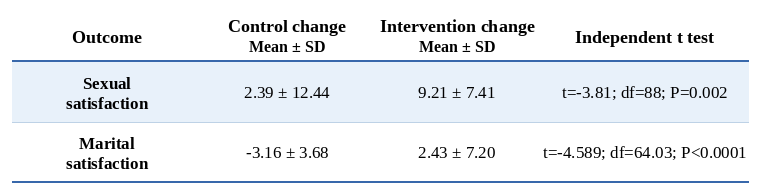
The mean change in sexual satisfaction was 9.21±7.41 in the intervention group compared with 2.39±12.44 in the control group (t=-3.81, df=88, P=0.002). Marital satisfaction increased significantly from baseline in the intervention group (t=-2.242, df=43, P=0.030), while the control group showed a significant decrease (t=5.696, df=43, P<0.0001). The mean change in marital satisfaction was +2.43±7.20 in the intervention group and -3.16±3.68 in the control group (t=-4.589, df=64.03, P<0.0001). These findings consistently favored expressive writing for both study outcomes.
Table 3. Comparison of mean changes in sexual and marital satisfaction scores after versus before the intervention.
Conclusion
A four-week, home-based expressive-writing intervention performed at least once weekly improved both sexual satisfaction and marital satisfaction in married women with MS. These findings support expressive writing as a complementary supportive intervention for women with MS. The study was conducted during the COVID-19 pandemic, and the psychological effects of the pandemic could not be controlled; this limitation should be considered when interpreting the findings. Larger studies are warranted to confirm the observed improvements in sexual and marital satisfaction.
Keywords: Multiple Sclerosis, Sexual satisfaction, Written expression
REFERENCES
- Jia D, Zhang Y, Yang C. The incidence and prevalence, diagnosis, and treatment of multiple sclerosis in China: a narrative review. Neurological Sciences. 2022;43(8):4695-700. PMID: 35583839 DOI: 10.1007/s10072-022-06126-4
- Mohebi F, Eskandarieh S, Mansournia MA, Mohajer B, Sahraian MA. Multiple Sclerosis in Tehran: Rising Prevalence alongside Stabilizing Incidence - True Increase or Enhanced Diagnosis? Arch Iran Med. 2019;22(8):429-434. PMID: 31679345
- Merghati Khoei E, Qaderi K, Amini L, Haghani H. Study on Sexual Behavior and Quality of Life of Women with Multiple Sclerosis Referred to Iran MS Society in Tehran in 2010. The Iranian Journal of Obstetrics, Gynecology and Infertility. 2012;15(5):7-14. DOI: 10.22038/IJOGI.2012.5726
- Lamaita R, Melo C, Laranjeira C, Barquero P, Gomes J, Silva-Filho A. Multiple Sclerosis in Pregnancy and its Role in Female Fertility: A Systematic Review. JBRA Assisted Reproduction. 2021;25(3):493-9. PMID: 34061482 DOI: 10.5935/1518-0557.20210022
- Guo ZN, He SY, Zhang HL, Wu J, Yang Y. Multiple sclerosis and sexual dysfunction. Asian J Androl. 2012;14(4):530-5. PMID: 22447199 DOI: 10.1038/aja.2011.110
- O'Mahony J, Salter A, Ciftci-Kavaklioglu B, Fox RJ, Cutter GR, Marrie RA. Physical and Mental Health-Related Quality of Life Trajectories Among People With Multiple Sclerosis. Neurology. 2022;99(14):e1538-e48. PMID: 35948450 DOI: 10.1212/WNL.0000000000200931
- Aydin T, Onger ME. Depression, sexual dysfunction, life satisfaction and marriage satisfaction in women with multiple sclerosis. Egypt J Neurol Psychiatry Neurosurg. 2022;58(1):73. DOI: 10.1186/s41983-022-00501-w
- Afshar B, Amini L, Nabavi SM, Mohammadnouri M, Jahanfar S, Hasani M. Effect of Expressive Writing on Promotion of Body Image in Women with Multiple Sclerosis: A Randomized Controlled Trial. J Mazandaran Univ Med Sci. 2021;30(192):54-67.
- Salari N, Hasheminezhad R, Abdolmaleki A, Kiaei A, Razazian N, Shohaimi S, Mohammadi M. The global prevalence of sexual dysfunction in women with multiple sclerosis: a systematic review and meta-analysis. Neurol Sci. 2023;44(1):59-66. PMID: 36114398 DOI: 10.1007/s10072-022-06406-z
- Scheepe JR, Alamyar M, Pastoor H, Hintzen RQ, Blok BF. Female sexual dysfunction in multiple sclerosis: Results of a survey among Dutch urologists and patients. Neurourol Urodyn. 2017;36(1):116-20. PMID: 26493281 DOI: 10.1002/nau.22884
- Bronner G, Elran E, Golomb J, Korczyn AD. Female sexuality in multiple sclerosis: the multidimensional nature of the problem and the intervention. Acta Neurol Scand. 2010;121(5):289-301. PMID: 20070276 DOI: 10.1111/j.1600-0404.2009.01314.x
- Donze C, Hautecoeur P. Troubles sphincteriens au stade precoce de la sclerose en plaques [Urinary, sexual, and bowel disorders in early-stage multiple sclerosis]. Rev Neurol (Paris). 2009;165 Suppl 4:S148-55. PMID: 19361680 DOI: 10.1016/S0035-3787(09)72127-7
- Valvano AK, Rollock MJD, Hudson WH, Goodworth MR, Lopez E, Stepleman L. Sexual communication, sexual satisfaction, and relationship quality in people with multiple sclerosis. Rehabil Psychol. 2018;63(2):267-75. PMID: 29878831 DOI: 10.1037/rep0000203
- Ajilchi B, Oskoei AS, Kargar FR. Marital satisfaction and mental health in multiple sclerosis patients' and healthy individuals' accordance to sex. Psychology. 2013;4(11):845. DOI: 10.4236/psych.2013.411121
- Meston CM, Lorenz TA, Stephenson KR. Effects of expressive writing on sexual dysfunction, depression, and PTSD in women with a history of childhood sexual abuse: results from a randomized clinical trial. J Sex Med. 2013;10(9):2177-89. PMID: 23875721 DOI: 10.1111/jsm.12247
- Baikie KA, Wilhelm K. Emotional and physical health benefits of expressive writing. Advances in Psychiatric Treatment. 2005;11(5):338-46. DOI: 10.1192/apt.11.5.338
- Hasanzadeh P, Fallahi Khoshknab M, Norozi K. Impacts of Journaling on Anxiety and stress in Multiple Sclerosis patients. CMJA. 2012;2(2):183-193.
- Newland P, Bettencourt BA, Schares S, Hendricks-Ferguson V. Testing of Journal Writing for Symptom Concordance in Adults with Multiple Sclerosis. Int J MS Care. 2021;23(4):157-161. PMID: 34483754 DOI: 10.7224/1537-2073.2019-108
- Wells T, Albright L, Keown K, Tkatch R, Duffy M, Wu L, et al. Expressive Writing: Improving Optimism, Purpose, and Resilience Writing and Gratitude. Innov Aging. 2018;2(Suppl 1):241. DOI: 10.1093/geroni/igy023.900
- Mahsa G, Rozita J, Mehdi M, Mohammad Ali S, Amirreza A. Sexual Function in Women with Multiple Sclerosis. Acta Med Iran. 2014;52(4):315-8. PMID: 24901864
- Bahrami N, Yaghoob Zadeh A, Sharif Nia H, Soliemani MA, Haghdoost AA. Validity and reliability of the Persian version of Larson sexual satisfaction questionnaire in couples. Journal of Kerman University of Medical Sciences. 2016;23(3):344-56.
- Adibkia A, Emamipour S, Keshavarzi Arshadi F, Mohammadkhani P. The Relationship Between Irrational Beliefs and the Marital Satisfaction Based on the Mediating Role of the Conflict Resolution Behavior and the Marital Stress. PCP. 2022;10(3):225-32. DOI: 10.32598/jpcp.10.3.779.1
- Arab Alidousti A, Nakhaee N, Khanjani N. Reliability and validity of the Persian versions of the ENRICH marital satisfaction (brief version) and Kansas Marital Satisfaction Scales. Health and Development Journal. 2015;4(2):158-67.
- Halpert A, Rybin D, Doros G. Expressive writing is a promising therapeutic modality for the management of IBS: a pilot study. Am J Gastroenterol. 2010;105(11):2440-8. PMID: 20551938 DOI: 10.1038/ajg.2010.246
- Montazeri M, Esmaeilpour K, Mohammad-Alizadeh-Charandabi S, Golizadeh S, Mirghafourvand M. The Effect of Writing Therapy on Anxiety in Pregnant Women: A Randomized Controlled Trial. Iran J Psychiatry Behav Sci. 2020;14(2):e98256. DOI: 10.5812/ijpbs.98256
- O'Connor DB, Hurling R, Hendrickx H, Osborne G, Hall J, Walklet E, Whaley A, Wood H. Effects of written emotional disclosure on implicit self-esteem and body image. Br J Health Psychol. 2011;16(3):488-501. PMID: 21722272 DOI: 10.1348/135910710X523210
- Smyth JM, Johnson JA, Auer BJ, Lehman E, Talamo G, Sciamanna CN. Online Positive Affect Journaling in the Improvement of Mental Distress and Well-Being in General Medical Patients With Elevated Anxiety Symptoms: A Preliminary Randomized Controlled Trial. JMIR Mental Health. 2018;5(4):e11290. PMID: 30530460 DOI: 10.2196/11290
- Pennebaker JW, Chung CK. Expressive Writing: Connections to Physical and Mental Health. In: Friedman HS, editor. The Oxford Handbook of Health Psychology. Oxford University Press. 2011.