

³ Social Determinants of Health Research Center, Health Research Institute, Babol University of Medical Sciences, Babol, Iran
⁴ General Physician, Babol University of Medical Sciences, Babol, Iran
*Corresponding author: Alireza Azizi, Department of Psychiatry, School of Medicine, Babol University of Medical Sciences, Babol, Iran. Email: azizi.a.re@gmail.com
EXTENDED ABSTRACT
Background
Suicide is a critical public-health problem shaped by interacting individual, social, and cultural factors. Although reported suicide rates have historically been lower in predominantly Islamic countries, suicide mortality has shown an increasing trend [1], and the reported rate in Iran has reached 9.9 per 100,000 population [2]. Major theories emphasize psychological pain, social disconnection, and hopelessness [3-5]. Because most people with suicidal thoughts do not attempt suicide, ideation must be distinguished from the transition to action [6, 7]. The interpersonal theory proposes that thwarted belongingness and perceived burdensomeness contribute to suicidal desire, while suicidal capability facilitates transition to an attempt [8]. The Three-Step Theory (3ST) extends the ideation-to-action framework. In its first step, suicidal ideation emerges when psychological pain and hopelessness are both high; in the second step, connectedness or belongingness can protect against escalating ideation; and in the third step, suicidal capacity determines whether strong ideation progresses toward an attempt [6, 9]. Studies in community, psychiatric, and student samples have supported the pain-by-hopelessness interaction and the role of suicidal capacity [10-13]. Iranian studies had evaluated related constructs, but the principal interaction hypotheses of the 3ST had not been directly examined [14, 15]. The present study therefore evaluated the relationships among pain, hopelessness, belongingness, perceived burdensomeness, suicidal ideation, suicidal capacity, and history of suicide attempt in psychiatric inpatients with suicidal ideation.
Methods
This descriptive-analytic cross-sectional study was conducted among psychiatric inpatients aged 18-65 years with suicidal ideation at Shahid Yahya Nejad Hospital in Babol during the first half of 2021. The required sample was estimated at 220 using G*Power 3.1.9.7; questionnaires were offered to 260 patients, and 224 complete questionnaires were analyzed. Participants were recruited according to eligibility criteria. Inclusion criteria were informed consent, suicidal ideation, psychiatric hospitalization, at least fifth-grade education, age 18-65 years, and full consciousness. Exclusion criteria included psychotic disorders or a current psychotic episode, cognitive impairment, a current manic episode, withdrawal, and incomplete questionnaires. History of suicide attempt was assessed with the relevant item of the Self-Injurious Thoughts and Behaviors Interview [16]. Suicidal ideation was assessed with the first five items of the Beck Scale for Suicide Ideation [17-19]. Psychological pain was measured using the 13-item Psychache Scale [20]. Hopelessness was assessed with the 20-item Beck Hopelessness Scale [21, 22]. Thwarted belongingness and perceived burdensomeness were assessed using the 15-item Interpersonal Needs Questionnaire [23, 24]. Suicidal capacity was assessed with the six-item Suicide Capacity Scale-3 [6, 25]. Descriptive statistics, Pearson correlations, independent-samples t tests, analysis of variance, hierarchical regression, and logistic regression were used. Hierarchical regression tested interaction effects on suicidal ideation, and logistic regression examined predictors of attempt history. Analyses were performed in SPSS version 27. The study was approved by the ethics committee of Babol University of Medical Sciences (IR.MUBABOL.REC.1399.398), and written informed consent was obtained from all participants.
Results
The 224 participants had a mean age of 32.90±10.14 years (range, 18-56 years); 114 (50.9%) were women and 110 (49.1%) were men. Sixty-three patients (28.1%) reported at least one previous suicide attempt, whereas 161 (71.9%) reported suicidal ideation without an attempt history. Diagnoses included major depression in 85 patients (37.94%), bipolar depressive episodes in 72 (32.14%), substance use in 54 (24.10%), and personality disorders in 52 (23.21%), with some comorbidity. No statistically significant sex differences were observed in suicidal ideation, pain, hopelessness, thwarted belongingness, perceived burdensomeness, or suicidal capacity. Suicidal ideation was significantly correlated with pain (r=0.69), hopelessness (r=0.61), thwarted belongingness (r=0.49), perceived burdensomeness (r=0.38), and suicidal capacity (r=0.20).
Hierarchical regression showed that the interaction between pain and hopelessness significantly predicted suicidal ideation (t=5.01, P<0.01). Pain and hopelessness together explained 63.6% of the variance in suicidal ideation, and the interaction term contributed an additional 3.7% beyond their main effects. The partial correlation between the interaction term and suicidal ideation after controlling for main effects was 0.32. When patients were grouped according to median levels of pain and hopelessness, mean suicidal ideation scores were 3.39 in the low-pain/low-hopelessness group, 3.93 when either pain or hopelessness was high, and 7.68 when both pain and hopelessness were high; the overall group difference was significant (F=126.07, P<0.01). The pain-by-hopelessness interaction was significant in both men (t=2.59, P<0.05) and women (t=4.59, P<0.05).
Figure 1. Mean suicidal ideation scores across groups defined by pain and hopelessness.
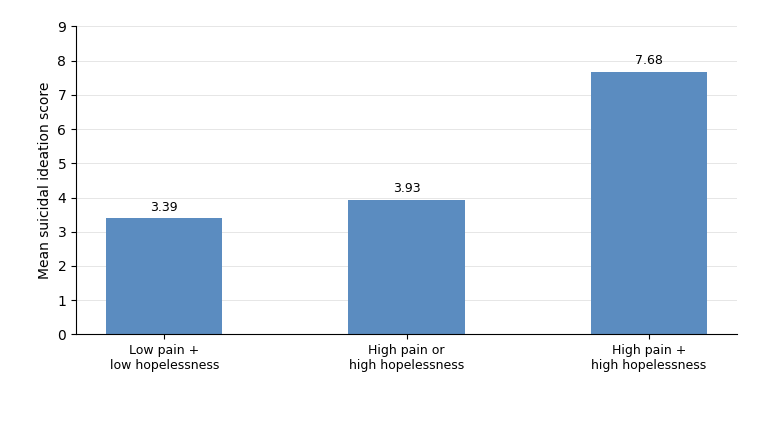
Table 2. Summary of hierarchical regression analysis for predicting suicidal ideation.

Thwarted belongingness and perceived burdensomeness explained 49.8% of the variance in suicidal ideation, less than the 63.6% explained by pain and hopelessness. Their interaction was nevertheless significant for predicting suicidal ideation (t=2.16, P<0.05). In the high-pain/high-hopelessness subgroup, the correlation between thwarted belongingness and suicidal ideation was r=0.53 versus r=0.19 in others. The pain-minus-belongingness interaction with high-pain/high-hopelessness status was significant (t=-3.70, P<0.01), consistent with a protective role for belongingness.
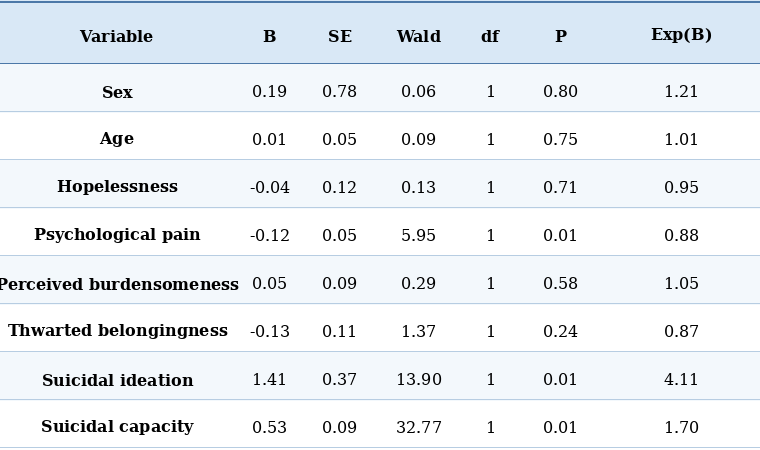
Patients with a previous suicide attempt had significantly higher dispositional (t=-18.86, P<0.01), acquired (t=-21.72, P<0.01), practical (t=-19.24, P<0.01), and total suicidal-capacity scores (t=-25.45, P<0.01) than patients with suicidal ideation but no attempt history. In logistic regression, psychological pain (B=-0.12, P=0.01; Exp[B]=0.88), suicidal ideation (B=1.41, P=0.01; Exp[B]=4.11), and suicidal capacity (B=0.53, P=0.01; Exp[B]=1.70) were significant predictors of suicide-attempt history, whereas sex, age, hopelessness, perceived burdensomeness, and thwarted belongingness were not statistically significant in the model.
Table 3. Logistic regression analysis predicting history of suicide attempt.
Conclusion
The findings support core propositions of the Three-Step Theory in these Iranian psychiatric inpatients. High psychological pain combined with high hopelessness was strongly associated with more severe suicidal ideation, while belongingness appeared to have a protective role, particularly in the subgroup with high pain and hopelessness. Suicidal capacity differentiated patients with an attempt history from those with ideation alone and remained a significant predictor in logistic regression. Accordingly, prevention should first address psychological pain and hopelessness, then strengthen connectedness, and finally assess suicidal capacity together with ideation and psychological pain. The cross-sectional design, retrospective attempt history, and self-report measures limit causal and prospective interpretation.
Keywords: Suicide, Suicide Attempted, Suicidal Ideation
REFERENCES
- Pritchard C, Amanullah S. An analysis of suicide and undetermined deaths in 17 predominantly Islamic countries contrasted with the UK. Psychological Medicine. 2007;37(3):421-30. PMID: 17176500 DOI: 10.1017/S0033291706009159
- Hassanian-Moghaddam H, Zamani N. Suicide in Iran: The Facts and the Figures from Nationwide Reports. Iran J Psychiatry. 2017;12(1):73-7. PMID: 28496505
- Shneidman ES. Suicide as psychache: A clinical approach to self-destructive behavior. Northfield, NJ: Jason Aronson; 1993.
- Durkheim E. Suicide: A study in sociology. New York, NY: Free Press; 1951.
- Abramson LY, Alloy LB, Hogan ME, Whitehouse WG, Gibb BE, Hankin BL, et al. The hopelessness theory of suicidality. In: Joiner TE, Rudd MD, editors. Suicide science: Expanding the boundaries. Kluwer Academic/Plenum Publishers. 2000:17-32.
- Klonsky ED, May AM. The three-step theory (3ST): A new theory of suicide rooted in the ‘ideation-to-action’ framework. International Journal of Cognitive Therapy. 2015;8(2):114-29.
- Nock MK, Borges G, Bromet EJ, Alonso J, Angermeyer M, Beautrais A, et al. Cross-national prevalence and risk factors for suicidal ideation, plans and attempts. Br J Psychiatry. 2008;192(2):98-105. PMID: 18245022 DOI: 10.1192/bjp.bp.107.040113
- Joiner T. Why people die by suicide. Harvard University Press; 2005.
- Swanson SP, Roberts LJ, Chapman MD. Are anaesthetists prone to suicide? A review of rates and risk factors. Anaesthesia and Intensive Care. 2003;31(4):434-45. PMID: 12973968 DOI: 10.1177/0310057X0303100413
- Pachkowski MC, Hewitt PL, Klonsky ED. Examining suicidal desire through the lens of the three-step theory: A cross-sectional and longitudinal investigation in a community sample. J Consult Clin Psychol. 2021;89(1):1-10. PMID: 33507772 DOI: 10.1037/ccp0000546
- Tsai M, Lari H, Saffy S, Klonsky ED. Examining the Three-Step Theory (3ST) of Suicide in a Prospective Study of Adult Psychiatric Inpatients. Behavior Therapy. 2021;52(3):673-85. PMID: 33990241 DOI: 10.1016/j.beth.2020.08.007
- Yang L, Liu X, Chen W, Li L. A Test of the Three-Step Theory of Suicide among Chinese People: A Study Based on the Ideation-to-Action Framework. Arch Suicide Res. 2019;23(4):648-61. PMID: 30024342 DOI: 10.1080/13811118.2018.1497563
- Dhingra K, Klonsky ED, Tapola V. An Empirical Test of the Three-Step Theory of Suicide in U.K. University Students. Suicide Life Threat Behav. 2019;49(2):478-87. PMID: 29604120 DOI: 10.1111/sltb.12437
- Kiani Chalmari A, Safdarian Z, Jafari Banafshedaragh A, Ahmadbookani S. Three-Step Structural Assessment of Suicide (Hopelessness, Ache, Depression, Interpersonal Needs, Acquired Capability for Suicide, and Suicide Attempt) in Students. Journal of Counseling Research. 2021;19(76):92-117. DOI: 10.29252/jcr.19.76.92
- Ghaleban K, Moheb N, Abdi R, Farnam A. The role of pain, hopelessness, belonging, and suicide capacity in predicting suicide attempt in people with psychiatric disorders. Med J Tabriz Univ Med Sci. 2022;44(1):36-46. DOI: 10.34172/mj.2022.012
- Nock MK, Holmberg EB, Photos VI, Michel BD. Self-Injurious Thoughts and Behaviors Interview: development, reliability, and validity in an adolescent sample. Psychol Assess. 2007;19(3):309-17. PMID: 17845122 DOI: 10.1037/1040-3590.19.3.309
- Beck AT, Steer RA. Manual for the Beck Scale for Suicide Ideation. San Antonio, TX: Psychological Corporation; 1991.
- Anisi J, Fathi Ashtiani A, Salimi S, Ahmad Noudeh K. Validity and reliability of Beck suicide scale ideation among soldiers. Journal of Military Medicine. 2005;7(1):33-7.
- Holden RR, DeLisle MM. Factor Analysis of the Beck Scale for Suicide Ideation With Female Suicide Attempters. Assessment. 2005;12(2):231-8. PMID: 15914724 DOI: 10.1177/1073191105274925
- Holden RR, Mehta K, Cunningham EJ, McLeod LD. Development and preliminary validation of a scale of psychache. Canadian Journal of Behavioural Science. 2001;33(4):224-32. DOI: 10.1037/h0087144
- Beck AT, Steer RA. Manual for the Beck Hopelessness Scale. San Antonio, TX: Psychological Corporation; 1988.
- Mesbah N, Abedian A. The relationship of stress and hopelessness among students residing in dormitories. Iranian Journal of Psychiatry and Clinical Psychology. 2006;12(2):154-9.
- Hill RM, Rey Y, Marin CE, Sharp C, Green KL, Pettit JW. Evaluating the Interpersonal Needs Questionnaire: Comparison of the Reliability, Factor Structure, and Predictive Validity across Five Versions. Suicide Life Threat Behav. 2015;45(3):302-14. PMID: 25308815 DOI: 10.1111/sltb.12129
- Kiani A, Ahmadboukani S, Najafi N, Gorji Z. Validation and Psychometric Properties of the Interpersonal Needs Questionnaire in Students. Research in Cognitive and Behavioral Sciences. 2019;9(2):65-78. DOI: 10.22108/cbs.2021.125926.1467
- Ahmadboukani S, Ghamari Kivi H, Kiani A, Rezaeisharif A. Structural validity of the Persian version of the Suicide Capacity Scale among Iranian college students. Perspect Psychiatr Care. 2022;58(4):2190-8. PMID: 35141900 DOI: 10.1111/ppc.13046
- Kleiman EM, Turner BJ, Fedor S, Beale EE, Huffman JC, Nock MK. Examination of real-time fluctuations in suicidal ideation and its risk factors: Results from two ecological momentary assessment studies. J Abnorm Psychol. 2017;126(6):726-38. PMID: 28481571 DOI: 10.1037/abn0000273
- Zareian B, Klonsky ED. Connectedness and suicide. In: Page AC, Stritzke WGK, editors. Alternatives to Suicide. Academic Press. 2020:135-58. DOI: 10.1016/B978-0-12-814297-4.00007-8
- Barber CW, Miller MJ. Reducing a suicidal person's access to lethal means of suicide: a research agenda. Am J Prev Med. 2014;47(3 Suppl 2):S264-72. PMID: 25145749 DOI: 10.1016/j.amepre.2014.05.028
- Anestis MD, Law KC, Jin H, Houtsma C, Khazem LR, Assavedo BL. Treating the Capability for Suicide: A Vital and Understudied Frontier in Suicide Prevention. Suicide Life Threat Behav. 2017;47(5):523-37. PMID: 27862187 DOI: 10.1111/sltb.12311
- Hawton K. Restricting access to methods of suicide: Rationale and evaluation of this approach to suicide prevention. Crisis. 2007;28(Suppl 1):4-9. DOI: 10.1027/0227-5910.28.S1.4