

*Corresponding author: Ebrahim Zarrinkalam, Department of Physical Education and Sport Sciences, Hamedan Branch, Islamic Azad University, Hamedan, Iran. Email: zarrinkalam@gmail.com
EXTENDED ABSTRACT
Background
Heart rate is widely used to prescribe and monitor exercise intensity in sport, rehabilitation, and occupational exercise settings, alongside indices such as oxygen consumption and perceived fatigue [1, 2]. Because target exercise heart rate is commonly calculated as a proportion of maximum heart rate (HRmax), reliable determination of HRmax is fundamental to safe and appropriate workload prescription [3, 4]. Direct measurement during a maximal graded exercise test is regarded as the reference approach [5], but it requires equipment, time, trained personnel, and maximal effort and may not always be feasible. Regression equations are therefore frequently used to estimate HRmax [6-8]. The traditional Fox and Tanaka equations were derived mainly from adult populations [9, 10], and evidence indicates that adult age-based equations may provide inaccurate estimates in children and adolescents [7, 14, 15]. Pediatric-specific equations have consequently been proposed, including the Gelbart, Nikolaidis, Mahon, and Shargal equations [5, 16-18]. However, an equation developed in one population may not retain adequate validity in another because the relation between age and HRmax is weaker in youth and may also be influenced by maturation, body composition, resting heart rate, physical fitness, and testing modality. Before these equations are used to control exercise intensity in Iranian schoolchildren, their agreement with directly measured HRmax should be established. The present study therefore evaluated the validity and estimation error of selected pediatric HRmax prediction equations in healthy 8–12-year-old boys.
Methods
This applied correlational study included 205 healthy male students aged 8–12 years who volunteered from six elementary schools in districts 1 and 2 of Hamedan. Schools from both higher- and lower-socioeconomic areas were represented. Parents received a health questionnaire and written consent form. Students with cardiovascular, respiratory, neuromuscular, anatomical, or metabolic disorders were excluded. Age, height, weight, and body mass index were measured using standard procedures. Resting heart rate was recorded after 10 minutes of seated rest with a Riester ri-fox 1905 finger pulse oximeter; concurrent measurement with a Polar chest heart-rate transmitter in 10 participants showed high validity for the pulse oximeter (ICC=0.98).
HRmax was estimated with four equations developed for pediatric or adolescent populations: Shargal, HRmax=208.852−0.741×age [18]; Gelbart, HRmax=186+0.25×resting heart rate−0.14×weight [5]; Mahon, HRmax=158.4+0.44×resting heart rate+0.68×age [17]; and Nikolaidis, HRmax=223−1.44×age [16]. Direct HRmax was determined with a maximal incremental Bruce treadmill test [20]. Participants were instructed to avoid strenuous activity for two days before testing and to consume their last meal three hours before the test. Heart rate was continuously monitored with a chest transmitter. The measured value was accepted as a true maximal response when the test reflected maximal effort, including heart rate >180 beats/min, a Borg rating of perceived exertion ≥17, and observable exhaustion or inability to continue [21, 22]. The highest heart rate reached at the end of the graded test was recorded as measured HRmax. Afterward, participants completed a three-minute cool-down at 5 km/h with 0% grade. Maximal oxygen uptake was estimated from Bruce test duration using the equation reported in the source article. Normality was assessed with the Kolmogorov-Smirnov test. Agreement between measured and predicted HRmax was evaluated using Pearson correlation, paired t tests, and root mean square error (RMSE). Analyses were conducted in SPSS version 26 with P<0.05 considered statistically significant. The study was approved by the Ethics Committee of Hamadan University of Medical Sciences (IR.UMSHA.REC.1394.116).
Results
The 205 participants had a mean age of approximately 10.1 years. Mean height was 142.5±9.5 cm, mean weight was 37.1±10.1 kg, mean body mass index was 18.1±3.3 kg/m², resting heart rate was 85.2±8.9 beats/min, and estimated maximal oxygen uptake was 43.2±6.1 mL/kg/min. The directly measured HRmax during the Bruce test was 203.5±6.2 beats/min, with a range of 192–222 beats/min. Predicted mean HRmax values were 201.3±1.1 beats/min for Shargal, 202.1±2.5 for Gelbart, 202.8±4.0 for Mahon, and 208.3±2.1 for Nikolaidis.
Associations between predicted and measured HRmax were uniformly weak. Significant but weak correlations were observed for Gelbart (R=0.18) and Mahon (R=0.17), whereas the correlations for Shargal and Nikolaidis were R=0.09 and were not statistically significant. Paired comparisons showed significant differences between measured HRmax and estimates from the Shargal, Gelbart, and Nikolaidis equations (P<0.05), while the Mahon estimate did not differ significantly from the measured value. Using the article’s definition of mean difference as measured minus predicted HRmax, Shargal underestimated HRmax by 2.3±6.2 beats/min and Gelbart by 1.4±6.3 beats/min, whereas Nikolaidis overestimated HRmax by 4.8±6.3 beats/min. The Mahon equation showed the smallest mean difference, 0.7±6.8 beats/min. These comparisons are summarized in Table 2 and Figure 1.
Table 2. Comparison of predicted maximum heart rate with the directly measured criterion value (N=205).
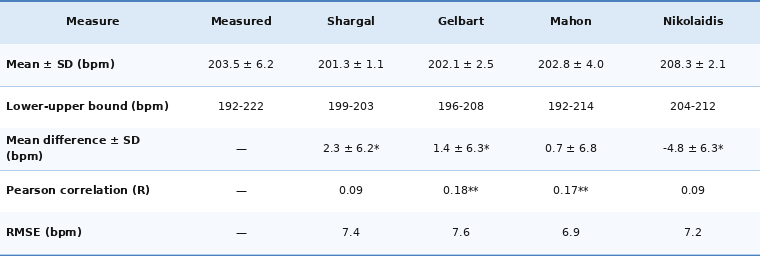
Figure 1. Mean maximum heart rate measured directly and estimated by the selected pediatric equations. Asterisks indicate a significant difference from directly measured HRmax.

Figure 2. Relationship between directly measured maximum heart rate and values predicted by the Shargal, Gelbart, Mahon, and Nikolaidis equations. The red line represents the 1:1 identity line.
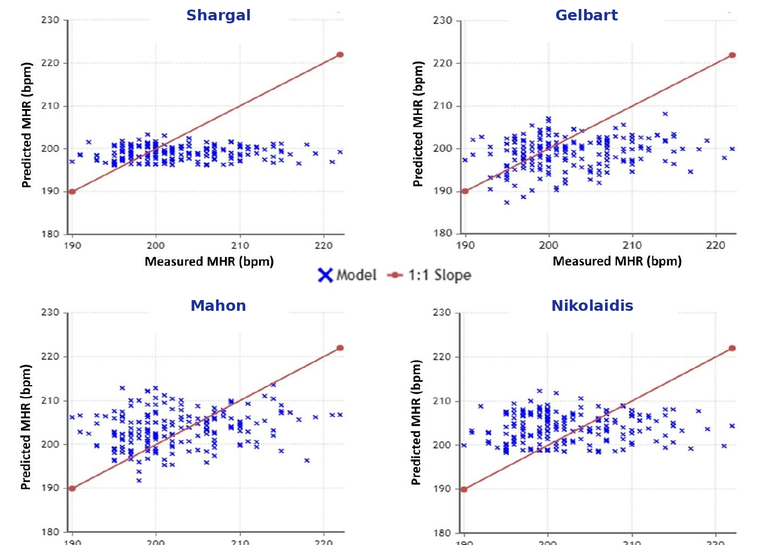
Figure 2 demonstrates the broad dispersion of predicted values around the identity line across all four equations, visually reinforcing the weak correlations and the limited individual-level agreement observed in the statistical analyses. Despite the relatively small mean biases for some equations, overall prediction error remained substantial. RMSE was 7.4 beats/min for Shargal, 7.6 for Gelbart, 6.9 for Mahon, and 7.2 for Nikolaidis. Thus, even the Mahon equation, which had the smallest RMSE and no statistically significant mean difference from measured HRmax, showed weak correlation with the criterion measure. Taken together, the low correlations, significant underestimation or overestimation by three equations, and RMSE values of approximately 7 beats/min indicated poor individual-level agreement between the foreign prediction equations and directly measured HRmax in this sample. The pattern supports the study’s interpretation that an equation may show an acceptable group mean yet still provide insufficient accuracy for prescribing exercise intensity in individual children.
Conclusion
The selected pediatric HRmax prediction equations did not demonstrate adequate validity in healthy Iranian boys aged 8–12 years. Shargal and Gelbart significantly underestimated HRmax, Nikolaidis significantly overestimated it, and all four equations showed weak convergence with directly measured HRmax and relatively high prediction error. Although the Mahon equation performed comparatively better, its error remained large enough to limit confidence in individual exercise prescription. These findings support development and validation of population-specific equations for Iranian children and caution against relying on foreign equations alone when HRmax is used to set exercise intensity. The study was limited to boys in a narrow age range, and motivation during maximal exercise could not be fully standardized.
Keywords: Exercise Intensity, Heart Rate, Students
REFERENCES
- Prieto-Gonzalez P, Yagin FH. Energy expenditure, oxygen consumption, and heart rate while exercising on seven different indoor cardio machines at maximum and self-selected submaximal intensity. Front Sports Act Living. 2024;6:1313886. PMID: 38390229 DOI: 10.3389/fspor.2024.1313886
- Kasiak PS, Wiecha S, Cieslinski I, Takken T, Lach J, Lewandowski M, et al. Validity of the maximal heart rate prediction models among runners and cyclists. J Clin Med. 2023;12(8):2884. DOI: 10.3390/jcm12082884
- Ruojiang L, Jinmei Q, Weizhen X, Feng W, Huihui Z. Consistency between the Standardized Methods of Exercise Prescription and the Target Heart Rate for the Cardiopulmonary Exercise Test in Individuals with Metabolic Syndrome. 2024. DOI: 10.21203/rs.3.rs-4002742/v1
- Shookster D, Lindsey B, Cortes N, Martin JR. Accuracy of Commonly Used Age-Predicted Maximal Heart Rate Equations. Int J Exerc Sci. 2020;13(7):1242-50. PMID: 33042384
- Gelbart M, Ziv-Baran T, Williams CA, Yarom Y, Dubnov-Raz G. Prediction of Maximal Heart Rate in Children and Adolescents. Clin J Sport Med. 2017;27(2):139-44. PMID: 27177205 DOI: 10.1097/JSM.0000000000000315
- Lach J, Wiecha S, Sliz D, Price S, Zaborski M, Cieslinski I, Postula M, Knechtle B, Mamcarz A. HR max prediction based on age, body composition, fitness level, testing modality and sex in physically active population. Front Physiol. 2021;12:695950. DOI: 10.3389/fphys.2021.695950
- Cicone ZS, Holmes CJ, Fedewa MV, MacDonald HV, Esco MR. Age-Based Prediction of Maximal Heart Rate in Children and Adolescents: A Systematic Review and Meta-Analysis. Res Q Exerc Sport. 2019;90(3):417-28. PMID: 31157608 DOI: 10.1080/02701367.2019.1615605
- Kittrell HD, DiMenna FJ, Arad AD, Oh W, Hofer I, Walker RW, et al. Discrepancy between predicted and measured exercise intensity for eliciting the maximal rate of lipid oxidation. Nutr Metab Cardiovasc Dis. 2023;33(11):2189-98. DOI: 10.1016/j.numecd.2023.07.014
- Tanaka H, Monahan KD, Seals DR. Age-predicted maximal heart rate revisited. J Am Coll Cardiol. 2001;37(1):153-6. PMID: 11153730 DOI: 10.1016/S0735-1097(00)01054-8
- Fox SM 3rd, Haskell WL. Physical activity and the prevention of coronary heart disease. Bull N Y Acad Med. 1968;44(8):950-67. PMID: 5243890
- Cicone ZS, Holmes CJ, Fedewa MV, MacDonald HV, Esco MR. The Validity Of Age-based Maximal Heart Rate Equations In Youth: A Systematic Review And Meta-analysis. Med Sci Sports Exerc. 2018;50(5S):665.
- Nikolaidis PT, Padulo J, Chtourou H, Torres-Luque G, Afonso J, Heller J. Estimating maximal heart rate with the '220-age' formula in adolescent female volleyball players: a preliminary study. Hum Mov. 2014;15(3):166-70. DOI: 10.1515/humo-2015-0007
- Cruz-Martinez LE, Rojas-Valencia JT, Correa-Mesa JF, Correa-Morales C. Maximum Heart Rate during exercise: Reliability of the 220-age and Tanaka formulas in healthy young people at a moderate elevation. Rev Fac Med. 2014;62(4):579-85.
- Pedroni AS, Schiavo A, Macedo ED, de Campos NE, Winck AD, Heinzmann-Filho JP. Predictive maximal heart rate equations in child and adolescent athletes: a systematic review. Fisioter Mov. 2018;31:e003131. DOI: 10.1590/1980-5918.031.AO31
- Komijani R, Jalili M, Nazem F. Cross-validation of Fox and Tanaka equations in predicting maximal heart rate of Iranian Children and Adolescent boys: Evaluation by the respiratory gas analyzer method in the exhaustive exercise test. J Sport Exerc Physiol. 2024;16(4):20-30. DOI: 10.48308/joeppa.2023.232504.1181
- Nikolaidis PT. Maximal heart rate in soccer players: measured versus age-predicted. Biomed J. 2015;38(1):84-9. PMID: 25179696 DOI: 10.4103/2319-4170.131397
- Mahon AD, Marjerrison AD, Lee JD, Woodruff ME, Hanna LE. Evaluating the prediction of maximal heart rate in children and adolescents. Res Q Exerc Sport. 2010;81(4):466-71. PMID: 21268470 DOI: 10.1080/02701367.2010.10599707
- Shargal E, Kislev-Cohen R, Zigel L, Epstein S, Pilz-Burstein R, Tenenbaum G. Age-related maximal heart rate: examination and refinement of prediction equations. J Sports Med Phys Fitness. 2015;55(10):1207-8.
- Bujang MA, Baharum N. Sample size guideline for correlation analysis. World. 2016;3(1):37-46.
- Bruce RA, Kusumi F, Hosmer D. Maximal oxygen intake and nomographic assessment of functional aerobic impairment in cardiovascular disease. Am Heart J. 1973;85(4):546-62. PMID: 4632004 DOI: 10.1016/0002-8703(73)90502-4
- Armstrong N, Welsman JR. Assessment and interpretation of aerobic fitness in children and adolescents. Exerc Sport Sci Rev. 1994;22(1):435-76.
- Wilder RP, Greene JA, Winters KL, Long WB 3rd, Gubler K, Edlich RF. Physical fitness assessment: an update. J Long Term Eff Med Implants. 2006;16(2):193-204. PMID: 16700660 DOI: 10.1615/jlongtermeffmedimplants.v16.i2.90
- Rowland TW. Evolution of maximal oxygen uptake in children. Pediatr Fitness. 2007;50:200-9. DOI: 10.1159/000101392
- Keteyian SJ, Steenson K, Grimshaw C, Mandel N, Koester-Qualters W, Berry R, et al. Among patients taking beta-adrenergic blockade therapy, use measured (not predicted) maximal heart rate to calculate a target heart rate for cardiac rehabilitation. J Cardiopulm Rehabil Prev. 2023;43(6):427-32. DOI: 10.1097/HCR.0000000000000806
- Machado FA, Denadai BS. Validity of maximum heart rate prediction equations for children and adolescents. Arq Bras Cardiol. 2011;97:136-40.
- Londeree BR, Moeschberger ML. Effect of age and other factors on maximal heart rate. Res Q Exerc Sport. 1982;53(4):297-304. DOI: 10.1080/02701367.1982.10605252
- Nikolaidis PT. Age-predicted vs. measured maximal heart rate in young team sport athletes. Niger Med J. 2014;55(4):314-20. PMID: 25114367 DOI: 10.4103/0300-1652.137192
- Atkinson G, Nevill AM. Statistical methods for assessing measurement error (reliability) in variables relevant to sports medicine. Sports Med. 1998;26(4):217-38. PMID: 9820922 DOI: 10.2165/00007256-199826040-00002